Showing posts with label Africa. Show all posts

Sunday, 23 December 2018

A Stroll in Jardin Majorelle

Greetings! When I was in Marrakesh, Morocco last month, I went to visit Jardin Majorelle (or The Majorelle Garden) one afternoon. The garden made such a lovely impression that I want to document it with some of my photos on my blog.

BRIEF HISTORY:

Jardin Majorelle was the creation of French painter Jacques Majorelle (1886-1962), who spent forty years injecting his passion and creativity into this magical garden. He painted the garden walls, fountains, features and villa in a fresh and intense blue colour, for which he trademarked the name Majorelle Blue.

Famed designer Yves Saint Laurent and Pierre Bergé, his longtime business partner and onetime life partner, bought Jardin Majorelle in 1980 and restored it. They transformed Majorelle's villa-studio into a museum open to the public, and dedicated to Berber culture.

Jardin Majorelle is one of the most visited sites in Morocco. It is a beautiful oasis in a bustling city. I hope my photos below show you why. Click to enlarge the pictures if you like.

JARDIN MAJORELLE MAIN FEATURES:

1. Fountain at the entrance: Before entering the garden itself, we see an enclosed space with a square fountain designed by renowned American decorator Bill Willis. I love everything about this fountain such as the light terracotta tile floor, the blue and green tiles around the fountain, the symmetrically arranged plants in terracotta pots, the soft sound of gurgling water, the hanging branches partially covers the door, and the curved walls that separate the garden from the bustling city outside.

Fountain at the entrance of Jardin Majorelle

2. Cacti: Although Jacques Majorelle collected many plants for his garden, he was especially interested in cacti. Out of respect for this passion, Yves Saint Laurent and Pierre Bergé continued to expand the collection, which today includes about thirty members of the cactus family. Some have been imported from the southwest regions of the United States.

Cacti in Jardin Majorelle

Plants in Jardin Majorelle

3. Majorelle Blue square fountain: This fountain is located in front of the Berber Museum, which used to be Jacques Majorelle's villa-studio. It's painted in his trademark Majorelle blue paint. I love the lemon yellow planters that accentuate the surrounding greenery and together they compliment the vibrant blue fountain. Similar to the fountain at the garden entrance, the soft trickling sound of water at this fountain has a soothing effect.

Square fountain painted in Majorelle blue

4. Berber Museum: The Berber Museum was officially inaugurated on the ground floor of the villa-studio of Jacques Majorelle in December 2011. More than 600 objects were on display inside the museum to introduce visitors into the Moroccan world of the Berbers.

Berber Museum in Jardin Majorelle

5. Museum Bookshop: The museum bookshop has an extensive selection of works about Morocco, and Berber art in particular. It is also an art gallery featuring a wide variety of antique photographs, watercolours, drawings and engravings dating from the 18th and 19th centuries. I like the intricate design of the bookshop windows, painted in yellow, as seen behind the cascading plants below.

A view of Museum Bookshop windows

6. Galerie Love: This gallery exhibits the 'Love' posters that Yves Saint Laurent created starting in the 70s to 2005. He sent them every year as New Year's greetings to his friends and the clients of his fashion house. I love the colours that Yves Saint Laurent used in his collage to create the posters.

Yves Saint Laurent's "Love' posters in Galerie Love

Galerie Love in Jardin Majorelle

7. Boutique Majorelle: The on-site boutique offers a wide range of unique, high quality clothing and products, designed exclusively for the Jardin Majorelle. From my quick browsing, I noticed a silk and cotton clothing line, silver jewellery, silk scarves, hand-woven textiles, embroidered leather cushions, leather goods, artisan soaps, and traditional handmade preserves. The displays were beautiful.

Boutique Majorelle

Boutique Majorelle

8. Water lily pool: I love everything about this pool. The reflections in the water, the water lilies, the koi fish, the aquatic plants, the Asian lotus flowers, the blue borders, and the lush vegetation in the garden. It looks like a wonderful spot to reflect and contemplate.

Water lily pool in Jardin Majorelle

9. Palm trees: There are many varieties of palm trees in Jardin Majorelle. Some of them have been imported from the South Pacific, eastern Africa, India, the Mediterranean basin and the Canary Islands. Palm trees and olive trees are considered holy in Morocco. I like how the red pathway or the terracotta grounds contrast with the green bamboo and palm trees.

Palm trees in Jardin Majorelle

Bamboo and Palm trees in Jardin Majorelle

10. Yves St Laurent Memorial: Yves Saint Laurent died on June 1, 2008. Peter Bergé died on September 8, 2017. The memorial in Jardin Majorelle, in memory of Yves Saint Laurent, is composed of a Roman column which came from his Tangier home and was placed on a terracotta base. A plaque bearing the names of Yves Saint Laurent and Peter Bergé and two white marble benches allow visitors to pause and remember.

Yves Saint Laurent Memorial in Jardin Majorelle

11. Bamboo: The little bamboo forest inside the garden provides pleasant green shades and a sense of tranquillity. There is a canal running through the garden with Majorelle blue borders. The reflections of the bamboo in the water add to the calming effect of the garden.

Bamboo in Jardin Majorelle

12. Pavilion: The pavilion was designed by Jacques Majorelle, who painted there. My photo below captures the steps leading to the Pavilion and the surrounding plants.

Steps leading to the Pavillion in Jardin Majorelle

Jardin Majorelle is an enchanting garden and very nice oasis in Marrakesh. I love its beauty and tranquillity. I love when I explore a new point of interest and it turns out to be a captivating discovery.

What do you think?

Sunday, 16 December 2018

Postcard from Casablanca, Morocco

Greetings! Last month I took a trip to visit Morocco. My itinerary included Rabat, Volubilis, Fez, Marrakesh, and Casablanca. You might like to read my posts on Rabat and Volubilis here, on Fez here, and on Marrakesh here.


 They're fascinating cities.

Today I'm sharing the top six sights that I've visited in Casablanca. I had included Casablanca in my trip itinerary since it was easier for me to book my flights home from this city.

Casablanca's Mohamed V International airport is about forty minutes by car from the city centre, in off-peak hours. If you're flying out from this airport, allow enough time to get there.


QUICK FACTS:
  • Casablanca is located about 90 km (56 miles) south west of the Moroccan capital of Rabat and bordering the Atlantic Ocean. 
  • Casablanca is the largest city in Morocco, with a population of almost 4 million and also boasts the world's largest artificial port. 
  • Casablanca is also the most liberal and progressive of Morocco's cities. Many young Moroccans speak to each other exclusively in French. 
  • Casablanca main colour is white. Unlike Marrakesh and Fez, there are high rise buildings in Casablanca.

TOP SIX SIGHTS IN CASABLANCA (Click to enlarge the pictures):

1. The Hassan II Mosque - Standing partly over the water, the enormous Hassan II Mosque, designed by the French architect Michel Pinseau, was completed in 1993. It has a 210 meters (690 feet) minaret topped with lasers directed toward Mecca. It's the largest mosque in Morocco and the third largest in the world.

Hassan II Mosque, Casablanca, Morocco

Fountain at Hassan II Mosque

The mosque has room for 25,000 worshippers inside, and a further 80,000 can be accommodated in the mosque's courtyard, which boasts a retractable roof. Astonishingly intricate decoration covers every centimeter of its surface. It is one of the two main mosques in Morocco open to non-Muslims who can visit the mosque on guided tours. One interesting tidbit: The Mosque's doors are made of Canadian titanium! Everything else is made of local Moroccan materials.

Doors at Hassan II Mosque

Ceilings and columns at Hassan II Mosque

Mosaic tile at Hassan II Mosque

2. The Corniche is a beachfront neighbourhood on the ocean, west of the Hassan II Mosque. Along the Boulevard de l'Ocean Atlantique are many newer, fancier hotels, and many western fast food chains. The best option is to walk up and down the street, and enjoy Moroccan tapas at one of the many ocean-view cafes. In the photo below, you can see the lighthouse in the distance.

Ocean view from Hassan II Mosque

A beach in Casablanca, Morocco

3. Place Mohammed V is the central plaza of Casablanca. It is home to many of the city's important official buildings, including the main post office, Palace of Justice, Prefecture, French consulate, and the main Bank of Morocco. In the photo below, if you zoom in to the signage of the Palace of Justice, under the roof, you see it is written in Arabic and Berber languages.

Place Mohammed V, Casablanca, Morocco

4. The Notre Dame de Lourdes is a church built in 1954-1956 by the French architect Gaston Zimmer. The church exterior includes a massive concrete ‘hood’ which towers over the doorways and is completed with a small crucifix attached at its highest point.

The Notre-Dame de Lourdes

It's the beautiful stained glass windows inside the church that capture everyone's attention. The open, airy interiors are lit up by the beams of light that filter through these stained glass windows which cover an entire wall of more than 800 square meters. The stained glass was created by French stained glass artist, Gabriel Loire.

Stained glass windows, Notre-Dame de Lourdes

Stained glass windows, Notre-Dame de Lourdes

Mother and Child stained glass

Unusual Devil stained glass

5. Rick's Café - If you’ve heard about Casablanca, it’s probably because of Casablanca, the Academy-award movie starring Humphrey Bogart and Ingrid Bergman in 1942. A replica of Rick's Café as seen in the movie was created ten years later in Casablanca's Old Town, within a 20 minute walk of the Hassan II Mosque and in the walls of the Old Medina bordering the ocean.

Rick's Café, Casablanca

My tour guide advised that the food is good at Rick's Café. Reservations and dress code are required for dinner. Alternatively, come here just for drinks at the bar, and soak up the 1940's Casablanca atmosphere.

6. Central Market - Casablanca's bustling central market is right in the city centre. It's where locals come to buy and sell. You'll find everything here from lamps, silver, spices, to Morocco's famous slippers. Be vigilante of your belongings and surroundings. If you're seriously interested in buying something, be prepared to haggle and disengage the negotiations amicably.

Moroccan silverware

Moroccan curry and Tagine mix

Moroccan beans and nuts

Moroccan jewelry boxes and wallets

IN CONCLUSION:

Casablanca is a busy city. It's well-connected to other cities and towns in Morocco by air, train, or bus so it's a convenient gateway. Its location by the Atlantic Ocean is a big draw in nice weather. In the city centre, I saw many Art Deco buildings which, if restored, would add more charms to the city.

I was glad that I had spent more time in Rabat, Volubilis, Fez, and Marrakesh. I found the layouts of these imperial cities more appealing than Casablanca, and their Medinas and ancient buildings or ruins a lot more fascinating than the Medina in Casablanca.

This is the last stop of my trip in Morocco. I've immensely enjoyed exploring this exotic country for the first time. It's a captivating destination. I've learned a lot from the places I've visited. I hope you enjoy my posts and photos.

What do you think? I'd love to hear your comments.

Sunday, 9 December 2018

Postcard from Marrakesh, Morocco

Greetings! Last month I took a trip to visit Morocco. My itinerary included Rabat, Volubilis, Fez, Marrakesh, and Casablanca. You might like to read my posts on Rabat and Volubilis here, and on Fez here. 


Today I'm sharing the top eight sights that I've visited in Marrakesh, one of the four imperial cities in Morocco. It is known as the City of Gardens or the Red City.

QUICK FACTS:
  • Marrakesh is located 327 km (203 miles) south west of the Moroccan capital of Rabat.
  • Marrakesh was founded in 1062.
  • The Medina of Marrakesh is a UNESCO World Heritage site.
  • The population of Marrakesh is about one million.
  • Marrakesh main colour is red sandstone or terracotta. Buildings are not allowed to be taller than the mosque in Marrakesh.

TOP EIGHT SIGHTS IN MARRAKESH (Click to enlarge the pictures):

1. Koutoubia Mosque: Koutoubia Mosque is the largest mosque in the city. It is made of red stone and brick and measures 80 metres (260 ft) long and 60 metres (200 ft) wide. The minaret is constructed from sandstone and stands 77 metres (253 ft) high. The spire atop the minaret is decorated with gilded copper balls that decrease in size towards the top, a style unique to Morocco.

View of Koutoubia Mosque, Marrakesh, Morocco

Koutoubia Mosque has inspired other buildings such as the Giralda of Seville in Spain (photo #14 in my Seville post), and the Hassan Tower of Rabat (#3 in my Rabat post).

Koutoubia Mosque, Marrakesh, Morocco

2. Saadian Tombs: Saadian Tombs were built in the 16th century as a mausoleum and final resting place for numerous Saadian sultans. The building has three rooms that contain the graves of about sixty members of the Saadi Dynasty. The main room displays fine Islamic architecture with marble columns, mosaic tile work, floral motifs, calligraphy, cedar wood carving, and stucco.

Saadian Tombs, Marrakesh, Morocco

Outside the building are unnamed graves of soldiers and servants and a garden with orange trees.

Soldiers and servants' graves at Saadian Tombs

3. The Bahia Palace: The Bahia Palace was built in the late 19th century by the Grand Vizier of Marrakesh, Bou Ahmed. Bahia means brilliance.

The Bahia Palace, Marrakesh, Morocco

The palace took seven years to build, with hundreds of craftsmen from Fez working on its wood, carved stucco, and mosaic tile. It is a stunning palace that can easily take hours to see all the details.

A ceiling in the Bahia Palace, Marrakesh, Morocco

The rooms in the Bahia Palace were designed to capture the essence of Islamic and Moroccan architectural styles. They open to courtyards such as the one in the photo below.

Back courtyard in the Bahia Palace, Marrakesh

4. The Medina of Marrakesh: The Medina of Marrakesh, a World Heritage site, is a labyrinth of small streets and alleyways leading to schools, mosques, souks, and houses. It is protected by the ramparts of Marrakesh, which stretch for some 19 kilometres (12 miles) around the medina of the city.

Built by the Almoravids in the 12th century, the walls are made of a distinct orange-red clay and chalk, giving the city its nickname as the "red city". They stand up to 5.8 meters (19 feet) high and have 20 gates and 200 towers along them. One of the gates is Bab Agnaou Gate. It's now a passage connecting both the medieval and modern parts of Marrakesh.

Bab Agnaou Gate, Marrakesh

5. Jemaa el-Fnaa (or La Place in French): This is one of the best-known squares in Africa. It's a place where there is something to see and do from morning to night. By day, the square buzzes with snake charmers, henna-tattoo artists, and various other entertainers. At night, there are countless food stalls selling traditional dishes and fresh orange juice. It's a busy place so be vigilant of your belongings and surroundings.

Jemaa el-Fnaa, Marrakesh, Morocco

6. The Souks (or Local Markets): Marrakesh boasts a full medina with traditional winding souks and countless treasures. Whether you're looking for food, cooking ingredients, household supplies, lamps, carpets, handicrafts, or literature, there's a street and alleyway for everything. Visitors can get lost for hours in the labyrinth of captivating streets.

Items for sale, Marrakesh, Morocco

Dried herbs and spices, Marrakesh, Morocco

Items for sale, Marrakesh, Morocco

Hand painted ceramics, Marrakesh, Morocco

Lamps, Marrakesh, Morocco

7. Jardin Majorelle: The Jardin Majorelle (or Majorelle Garden) is a beautiful oasis in a bustling city. It was the creation of French painter Jacques Majorelle, who spent forty years injecting his passion and creativity into this magical garden. He painted the garden walls, fountains, features and villa in a fresh and intense blue colour, for which he trademarked the name Majorelle Blue.

Famed designer Yves Saint Laurent and Pierre Bergé bought Jardin Majorelle in 1980 and restored it. They transformed Majorelle's studio into a museum open to the public, and dedicated to Berber culture. It's now called the Museum of Islamic Art.

Museum of Islamic Art

Fountain in Jardin Majorelle

Similar to the Bahia Palace, visitors can easily spend a few hours at the Jardin Majorelle to enjoy its beauty and tranquillity, as well as visit the Berber museum, and the Yves Saint Laurent boutique that are located in the garden. I've taken many photos in the garden that deserves a blog post on its own.

8. Ville Nouvelle: Outside the ancient walls of the Medina of Marrakesh is the newer part of the city. There are gardens, villas, museums, and shopping centres to explore. The sidewalks are clean and I like the green palm trees that line the main avenues and the red sandstone walls.

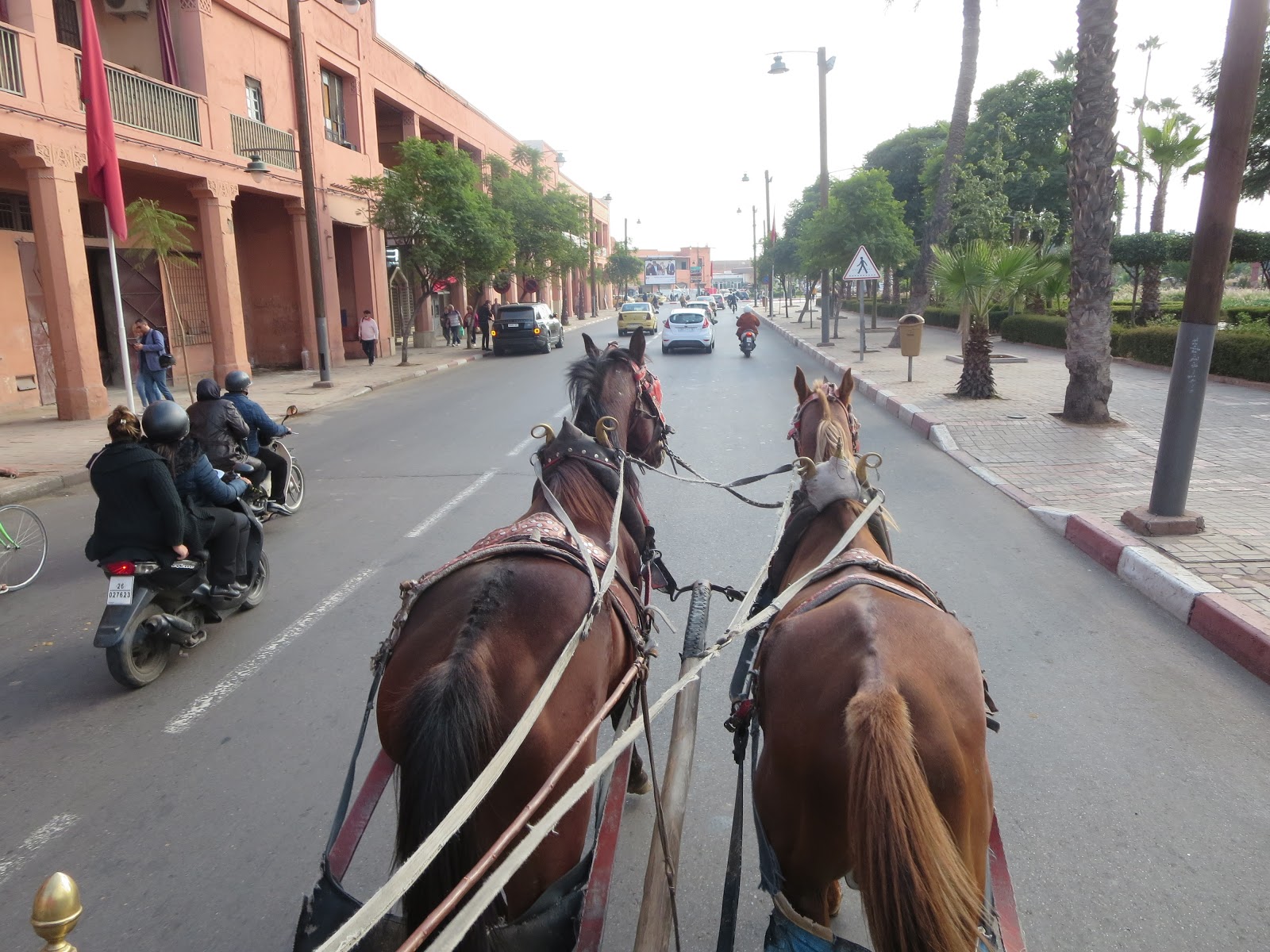
During my stay in Marrakesh, I met four American travellers from New York. We shared a horse carriage ride from Marrakesh main square, Jemaa el-Fnaa, to Ville Nouvelle area.

It's easy to find a horse carriage from the square and negotiate the price, just like you would with a taxi. As the horse owner and I conversed in French, he told me that he owned four horses, two of them work the morning shift, and the other two work the afternoon shift.

Horse carriage ride in Marrakesh

Ville Nouvelle, Marrakesh

MY CONCLUSION:

Marrakesh is a very captivating city with its ancient history and architecture. The souks alone offer incredible sights, sounds, smells, and textures. The Ville Nouvelle area seems to have more European presence than Fez, likely due to a large number of French people who have bought properties in the city.

I would have liked to stay longer to explore more sights and the museums in Marrakesh. However, it's time to move on to Casablanca, my last stop in Morocco before heading home. It's been so awesome to visit Rabat, Volubilis, Fez and Marrakesh up to this point on my trip.

What do you think? I'd love to hear your comments.