Showing posts with label Europe. Show all posts
Sunday, 30 June 2019
Malta Highlights
Greetings! A friendly reminder that I'm gradually moving from Blogger to WordPress. I plan to blog regularly on WordPress starting July 1. In the interim, I'm redirecting readers from this blog to my new blog location.
If you've been following my blog, thank you. I hope you continue to follow me at my new site.
If you have listed my blog in your blog roll, thank you. Please kindly update it to reflect my new blog location.
I'm sharing the highlights of my trip to Malta earlier this month. I hope to see you there!
Sunday, 26 May 2019
Croatia: Postcard from Zagreb
Greetings! After our adventures along the delightful Dalmatian Coast, and our multiple day trips to see the stunning Plitvice Lakes and Istria Peninsula, my sister and I continued to Zagreb, the capital of Croatia.
Today I'm sharing some photos that I took during our walks to explore Zagreb. We happened to be there on Friday and Saturday when the locals were out in full force to enjoy the sunny and warm weather.
We began our first walk at Kaptol Square in Zagreb's Upper Town, dominated by the huge Zagreb Cathedral, with its soaring twin spires, its cobblestone streets, and red tile roofed buildings.
![]() |
| Zagreb Cathedral and surrounding buildings |
From the Cathedral, we walked to the large Market with red umbrellas and many stands offering flowers, fruits, veggies, meats, as well as puppet toys, souvenirs, and household items. The streets near the market were packed with restaurants, trendy cafes, and a vibrant shopping scene.
![]() |
| Zagreb Market |
From the market, we walked to St. Mark's Church with its brightly coloured roof, Stone Gate (the stone gate into town with a Virgin Mary shrine popular for prayer and candle lighting), Strossmartre Gate, and Lotrscak Tower. This is a large tower with daily cannon blasts and an observation area providing panoramic city views and the view of the funicular.
![]() |
| St. Mark's Church, Stone Gate, Lotrscak Tower |
![]() |
| Views of Zagreb and the Funicular |
We continued to explore the winding streets of the Old Town and reached Ban Jelacic, the city's main square, accessible only by foot and by tram. It’s a popular meeting spot thanks to the giant statue of Josip Jelačić on his horse that acts as a convenient landmark.
![]() |
| Ban Jelacic, Zagreb's Main Square |
For our second walk, we started from the main square, and walked south towards Zagreb Central Train Station and the Botanical Garden in Zagreb's Lower Town. The parks, gardens, and fountains along this stretch are beautiful. On the weekend when we were there, the locals were out to enjoy the green space, outdoor art exhibits, blossoming trees, and sunshine.
![]() |
| Park and Central Station in Zagreb |
The main streets in Zagreb's Lower Town form a U-shaped or horseshoe-shaped area with many beautiful and big buildings. It would be time well-spent to explore the history and the architecture here.
![]() |
| Buildings in Zagreb |
| Building in Zagreb |
Zagreb is a charming and pedestrian-friendly city. We enjoyed our walks both in the Upper Town and Lower Town. The weekend was beautiful so even though there was an extensive tram network in Zagreb, we decided to walk and did not use the trams.
This city was our last stop in Croatia, before flying home from Zagreb International Airport. Our time in Croatia was amazing. I hope you've enjoyed visiting (or revisiting) Croatia through my lens.
I'd love to hear your comments.
Tuesday, 21 May 2019
Croatia: Stunning Plitvice Lakes and Istria Peninsula
Greetings! After our adventures along Croatia's delightful Dalmatian Coast, my sister and I continued with our tour to visit Croatia's Plitvice Lakes National Park and three towns on Croatia's Istria Peninsula (Opatija, Rovinj, and Pula).
We stayed overnight at Plitvice Lakes and spent a full day in Plitvice Lakes National Park. From there we moved on to stay overnight in Opatija, and took day trips from Opatija to Rovinj and Pula. We had a few stunning surprises waiting for us at each of the four locations, shown as blue markers in the map below. Plitvice Lakes National Park is the far right blue marker.
![]() |
| Croatia's Plitvice Lakes and Istria Peninsula |
PLITVICE LAKES NATIONAL PARK
Plitvice Lakes National Park is the oldest and largest national park in Croatia. It was designated as a national park in 1949, and as a UNESCO World Heritage Site in 1979. The park is famous for its sixteen turquoise-coloured lakes and numerous smaller lakes, separated by travertine barriers.
| Map of Plitvice Lakes National Park |
On the day of our visit to Plitvice Lakes National Park, we woke up to an overcast sky and a dusting of fresh snow which melted as the temperature rose. I had read about the Plitvice Lakes and was excited to explore this magnificent natural wonder.
Our tour guide got tickets for the group and walked us through various sections in the park. The park entrance ticket includes a 20-minute ride with the electric boat and a panoramic train as the park is a large area to discover. Raised wooden footpaths zigzag and curve to lead us through this natural beauty.
| Wooden path at Plitvice Lakes National Park |
| Zigzag wooden paths at Plitvice Lakes |
The views were spectacular no matter where we looked. The sixteen lakes terrace their way down a hillside, each one connected to the last via cascading waterfalls, caves, springs, and chutes. The highest falls, Veliki Slap, the tallest waterfall in Croatia, tumble some 78m. Altogether, the string of lakes is almost eight km (five miles) long.
![]() |
| Plitvice Lakes National Park, Croatia |
| Veliki Slap tall waterfall at 78 m |
![]() |
| Waterfalls and chutes at Plitvice Lakes |
There are four hiking trails, three caves, and a special beech-fir forest reserve for visitors to explore. I truly enjoyed our visit to Plitvice Lakes National Park. On a sunny day, or in the Fall, I imagine the park and colours of the lakes must be quite stunning.
OPATIJA
Opatija is about two hours drive north west of Plitvice Lakes. It's a charming town located on Croatia's Istria Peninsula, along Adriatic shores near the tip of the Gulf of Kvarner. Opatija has a fascinating cultural blend, Austro-Hungarian, Italian, Yugoslavian, and Croatian, over the centuries. With its close proximity to Italy, many Italians come here for rest and relaxation.
During our stay in Opatija, the sunny skies and warm temperatures returned. We strolled along Opatija's seaside promenade, the Lungo Mare, and soaked in the small city’s ambiance and lovely setting.
| Opatija, Croatia |
Some of Opatija's landmarks include the Maiden with the Seagull statue, the Boatman statue by the small harbour, Kvarner hotel, and the gardens.
![]() |
| Opatija's landmarks |
![]() |
| Opatija Gardens |
ROVINJ
From Opatija, we took a day trip to Rovinj, located about an hour drive south west of Opatija. Rovinj delighted us with its stunning sea views, Venetian architecture, and cobbled streets.
| Rovinj, Croatia |
It was a pleasure to walk and wander the small alleys in and around Rovinj. The houses all seem to exude charms and present numerous photo opportunities.
![]() |
| Sights in Rovinj, Croatia |
For a panoramic ocean view, we climbed the stone steps leading to Rovinj's church and walked the pebbled grounds before going towards the market. The local specialities include truffles, sauces, fruit jams and herbs such as lavender.
![]() |
| Sights in Rovinj, Croatia |
PULA
From Rovinj, we took a side trip to Pula, about 40 minute drive south of Rovinj. Walking towards Pula's centre, we were delighted to see Pula's remarkably well-preserved Roman amphitheater (or arena), where performances are still held today. It is the 6th largest amphitheater in Europe.
| Roman amphitheater in Pula, Croatia |
Without any tourist crowd, we were able to spend some time walking around the Roman arena and examining its structure in details. We could see the Adriatic sea through the arena's openings.
![]() |
| Roman arena in Pula, Croatia |
Further wanderings let us see more of Pula's interesting and historic landmarks such as the four shown in the photo below the Cathedral (top left), Temple of Augustus (top right), Town Hall (lower right) and Twin Gate (lower left).
![]() |
| Pula's Cathedral, Temple, Town Hall and Twin Gate |
Our time in Croatia's Plitvice Lakes National Park, Opatija, Rovinj, and Pula was truly amazing. I hope this post and my selected photos reflect the beauty of these places in Croatia. I plan to have one more post on Zagreb.
Thank you for travelling with me. I'd love to hear your comments.
Sunday, 12 May 2019
Croatia: Delightful Dalmatian Coast
Greetings! In March, my sister and I took a guided tour to visit Croatia and Slovenia. Our itinerary included one stop in Mostar in Bosnia and Herzegovina. I wrote about our day trip to Mostar here, and our wonderful time in Slovenia here.
While in Croatia, we started from Dubrovnik, travelled north with overnight stays along the Dalmatian Coast, Plitvice Lakes National Park, the Istria Peninsula, and ended with a two-night stay in Zagreb, Croatia's capital, before flying home.
At each location we had about one to two hours of walking with a local guide, followed by free time on our own until we met again to return to our hotel. The old towns are all cobble stoned and the best way to explore them is by walking. One exception is Plitvice Lakes National Park where our tour guide was with us for close to a full day.
We lucked out on at least three things:
- Our group size was twelve, including my sister and I, even though the tour was advertised with a maximum of twenty-two people. The participants were all Canadians, from various Canadian provinces. Everyone was friendly and prompt, which means no wasted time waiting around at meet-up times.
- The weather was superb for March, a transition month from winter to spring. We had sunny skies and pleasant temperatures throughout the entire trip, except one overnight stay at Plitvice Lakes National Park. On a couple of days, it felt like summer at 25C (77F).
- The tour went smoothly from beginning to end. We received all the services as outlined in our tour package. In hindsight, my sister and I both feel that we've got very good value for the 'flash sale' price we paid. In addition, by travelling in shoulder season, we didn't encounter any crowd or long queues at the main sights, or traffic jam on the highways, or delays at border crossings.
DALMATIAN COAST
Croatia's coastline is 1778 km long, with over a thousand islands dotted the Adriatic Sea, waiting to be explored. We flew from Toronto to Dubrovnik and started our guided tour in Dubrovnik. Our Dalmatian Coast adventures included four stops, shown as blue markers in the photo below: Dubrovnik, Split, Trogir, and Zadar. Click to enlarge the pictures.
![]() |
| Dalmatian Coast, Croatia |
DUBROVNIK
My first sight of Dubrovnik, a UNESCO World Heritage Site, was from a hill top, and it was as beautiful as I imagined it to be. The well-preserved citadel completely encircles the city, with red-tiled roofs within its 800 year-old medieval wall. On a clear and sunny day, Dubrovnik is a jaw-dropping beauty with the blue Adriatic Sea as its background, dotted with a few green islands.
Before entering Dubrovnik's Old Town, we stopped to take in the views of Fort Bokar and Fort Lovrijenac. Without a doubt, Dubrovnik is Croatia's gem. Its image is on the back of Croatia's 50 Kuna bill (Croatian's currency is the Kuna or HRK).
![]() |
| Dubrovnik: Fort Bokar, Fort Lovrijenac, on 50 HRK bill |
We entered Dubrovnik's Old Town from Pile Gate (top left in the photo below). The pristine marble streets in the Old Town are lined with baroque buildings, beautiful Renaissance fountains, and facades. Some of the important landmarks include: Stradun (the main street in Dubrovnik's Old Town), with the Franciscan church and monastery at one end (top right), Sponza Palace at the other end (bottom right), Rector's Palace, and Dubrovnik Cathedral (bottom left).
![]() |
| Pile Gate, Stradun, Sponza Palace, Dubrovnik Cathedral |
![]() |
| Dubrovnik's Bell Tower, Old Port, and City Walls |
At Dubrovnik's market, we tried a delicious local snack consisting of dried figs, orange rinds, and nuts. Then stopped by the Terrace by the Sea coffee shop by the Old Port for a good cappuccino while soaking in the views.
![]() |
| Dried figs, orange rinds, nuts, and cappuccino |
Dubrovnik's main attraction is the City Walls which are approximately 2 km long. With renewed energy after our coffee break, my sister and I decided to climb the narrow streets of the Old Town up to the northern walls for great views, and walked along the perimeter of the Old Town before meeting our group to return to our hotel. It was a gorgeous day in a beautiful city!
Split is Croatia's second largest and lesser known city. It's a town steeped in ancient history preserved over the course of 1700 years by its inhabitants. Emperor Diocletian chose Split as his retirement destination in 305 AD and had a grand palace built here to accommodate his post-imperial court. Today, the ancient Roman palace – a UNESCO World Heritage Site – serves as Split’s vibrant marketplace and its city center. The ancient narrow streets are alive with people, shops, bars, restaurants, and hotels.
| Columns at Diocletian Palace, Split, Croatia |
| Church and Statue of Gregory of Nil, Split, Croatia |
![]() |
| Split Cathedral, Alley, Theatre, and Fish vendor |
Split is also known as the jumping off point for a visit to the magical Mediterranean islands. Unlike Dubrovnik which has unfortunately become full-on touristy, Split is the place to discover real Dalmatian life in an atmospheric setting. On a beautiful sunny day, we strolled Split's seafront promenade which is lined with palm trees. We savoured the views of dramatic coastal mountains and shimmering sea, and mingled with the locals.
![]() |
| Split, Croatia |
![]() |
| Split, Croatia |
At our tour guide's recommendation, my sister and I ordered traditional Dalmatian pasticada with gnocchi and local wines for dinner. Pasticada is a stewed beef dish slow cooked in special sauce and served with homemade potato gnocchi for special occasions. We quite enjoyed this flavourful dish.
![]() |
| Pasticada with gnocchi in Split, Croatia |
TROGIR
Trogir is a medieval town developed in the 13th to the 15th centuries and another UNESCO World Heritage site. It's located about 29km west of Split.
We entered Trogir historic town centre via the Renaissance city gate. Above the gate is a statue of the town's protector, the Blessed Ivan Orsini. Trogir historic town centre is pedestrian-only and is like an outdoor museum. We walked to explore the beautiful facades, elegant churches and palaces, and medieval streets.
![]() |
| Trogir city gate, cathedral, and palace |
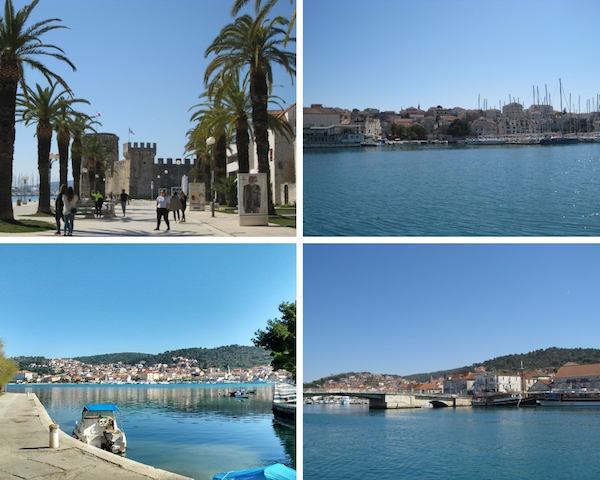
Trogir waterfront has a wide promenade perfect for walking. At one end is the Kamerlengo fortress which was built in the 14th century and used to be connected to the city walls. From the promenade, one can see the Trogir-Ciovo bridge and many sailboats.
![]() |
| Trogir waterfront |
At our tour guide's recommendation, we took a coffee break at Dovani restaurant which has a great pastry selection and coffee bar on the ground floor. The cake and coffee were some of the finest that we've had.
![]() |
| Cake and coffee in Trogir, Croatia |
ZADAR
Zadar is a walled Adriatic town like Dubrovnik, with Roman ruins, Venetian architecture, and a rich cultural heritage found on every corner. The city was awarded UNESCO World Heritage Site status in 2017.
One of the main attractions in Zadar is the Roman Forum, constructed from the 1st century BC until the 3rd century AD. It's the largest forum in Croatia. Here we see St Donatus church (the round pre-Romanesque church in the photo below), St Anastasia's Cathedral (right), column ruins (front), and the Pillar of Shame (left) which was used to punish evildoers during the Middle Ages.
| Roman Forum in Zadar, Croatia |
Zadar historic centre is pedestrian-only. The streets lead to several beautiful public squares. One of them is the People's Square (top left in photo below).
![]() |
| Public squares and Roman ruins, Zadar, Croatia |
Other landmarks shown in the photo below: St Mary's Church and the Benedictine Convent (top left), the ornate, late-Renaissance Land Gate dating from 1543 with a snarling Venetian lion over an effigy of St Chrysogonus on horseback (bottom left), the Captain's Tower and the Square of the Five Wells (bottom right).
![]() |
| St Mary's church, Buildings, Five Wells, Land Gate |
Zadar's waterfront is a great spot for strolling and watching the sunset. On the southwestern quay, we sat on the steps to listen to the Sea Organ. It's an urban installation and a musical instrument. Tubing within the stone steps transforms the movement of the waves and the sea breezes into a series of musical chords.
Nearby is the Greeting to the Sun, a remarkable installation made out of 300 photo-sensitive glass plates that absorb daylight and transform into a wondrous light show at night. Both the Sea Organ and the Greeting to the Sun installations are designed by Nicola Basic.
![]() |
| Sea Organ, Greeting to the Sun and Boardwalk |
While in Zadar, we tried a popular Croatian snack called Burek at the local Mlinar bakery. Burek is phyllo pastry filled with meat or spinach and cheese or just cheese in spiral shape. It's inexpensive and tasty.
![]() |
| Burek in Croatia |
I hope this blog post and my photos reflect how delightful Croatia's Dalmatian Coast is. In my next post(s), I plan to share my highlights of Croatia's Istria Peninsula, Plitvice Lakes National Park, and Zagreb.
Thank you for travelling with me. I'd love to hear your comments.
Thursday, 25 April 2019
3 Walks To Take in Slovenia
Greetings! Last month, my sister and I went on a guided tour to visit Croatia and Slovenia. Our itinerary included a day trip to historic Mostar in Bosnia and Herzegovina. I wrote about that picturesque and interesting day trip here.
Slovenia is a small country in south central Europe, with Italy to the west, Austria to the north, Hungary to the east, and Croatia to the south. Slovenia's population is about two million. Its official language is Slovenian, and its currency is the euro.
Today I'm sharing three fun walks that visitors would enjoy in Slovenia. I'd allow at least half a day for each walk since there are lots to see. Feel free to pick one, or two, or all three. The first walk is an urban walk in Ljubljana (Slovenia's capital), and the next two are nature walks by the lakes. Will you join me?
WALK #1 - LJUBLJANA OLD TOWN
Ljubljana is the capital of Slovenia. It is not to be confused with Bratislava, the capital of Slovakia. Ljubljana means beloved. The best buildings are in and around Ljubljana's finely preserved Old Town, along the Ljubljanica River, with bridges linking the two banks.
A good place to meet and start our walk is at Presernov Square by the bronze statue of France Peseren (1800-1849). From the statue, it's fun to watch the constant ebb and flow of people, or admire the architectural details of the buildings around it, such as the red Franciscan Church of the Annunciation, or Centromarkur, Ljubljana's oldest department store, marked by an Art Nouveau awning over the entrance. Click to enlarge the pictures.
Running south from Presernov Square to the Old Town is the much celebrated Triple Bridge. The bridge was originally called Špital (Hospital) Bridge and was built as a single span in 1842. Between 1929 and 1932 architect Jože Plečnik added the two pedestrian side bridges, furnished all three with stone balustrades and lamps, and forced a name change. Stairways on each of the side bridges lead down to the poplar-lined terraces along the Ljubljanica River.
After crossing the Triple Bridge, we're in the Old Town where some of the interesting landmarks include the Robba's Fountain (1751), and the Town Hall which we can visit for free. Exhibitions are occasionally held in the interior courtyard, like the lovely Pratneker's art exhibit that I discovered here.
Among several important religious buildings in Ljubljana's Old Town is the Cathedral of St. Nicholas, in baroque style, defined by its high dome and massive bell towers. The cathedral was designed by Andrea Pozzo in 1701. Its interiors are famous for frescoes by Quaglio, depicting miraculous moments in the life of St. Nicholas, the patron saint of all seafaring people. Worth a look are the bronze sculpted church doors, added for the 1996 visit of Pope John Paul II, whose image can be seen looking over the history of Slovene Christianity on the main doors.
Adjacent to the Cathedral is the Market. Just north of the market, crossing the Ljubljanica River out of Old Town, is Dragon's Bridge, designed by Jurij Zaninovich and completed in 1901, with four fabulously sculpted dragons adorn each corner of the bridge.
Leaving the Old Town, we can walk uphill or take a funicular to reach Ljubljana Castle which overlooks the entire city. It’s free to ramble around the castle grounds, but you’ll have to pay to enter the Watchtower and the Chapel of St George, and to see the Slovenian History Exhibition, visit the Puppet Theatre, and take the Time Machine tour.
This discovery walk #1 gives an introduction to charming Ljubljana. The city is small and compact so one can see plenty of it with little effort. Aside from the various visually interesting and historic landmarks in the Old Town, what I enjoy is the vibrant, youthful, and relaxing atmosphere along the river. There are plenty of coffee bars and restaurants to take a break or linger until sundown and mingle with the locals.
WALK #2 - LAKE BLED
From Ljubljana, it's an easy drive to Lake Bled. Bled is located 50km (31 miles) NW of Ljubljana, and Bohinj is 26km (16 miles) SW of Bled. It's doable to combine walk #2 and walk #3 on the same day. Click to enlarge the pictures.
Lake Bled is a lake fit for a fairy tale, complete with dramatically situated cliff-top castle, an island church, and wraparound mountain scenery.
Let's start from Bled Castle, located atop a sheer cliff, 138m (or 460 ft.) up. One can reach Bled Castle by foot (a 15 minute uphill walk) or 5 minute by car and a short climb up the final stretch. Bled Castle traces its history back to 1004. Today it houses a museum, a chapel, a historic wine cellar, a printing shop showing how printing was done in medieval times, a restaurant, and an ice cream shop.
The views from the castle ramparts are magnificent: Mount Triglav (Three Heads) the highest peak of the Julian Alps on one side, Bled Island and Lake Bled in the middle, and the Karavanke mountain range on the other side.
Mount Triglav (Three Heads): The 2864m limestone peak has been a source of inspiration and an object of devotion for Slovenes for more than a millennium – it even appears on the country's flag. The early Slavs believed the mountain to be the home of a three-headed deity who ruled the sky, the earth and the underworld.
Bled Island: As the only island in Slovenia, Bled Island forms a perfect centerpiece in Lake Bled. You can row (or be rowed) to Bled Island. On the island is the delightful Church of the Assumption, dedicated to both Mary the Virgin and Mary Magdalene. People from all over Slovenia come here to tie the knot on Saturdays. The tradition includes the groom carries the bride up the 99 stairs to the church.
Going from Bled Castle down to the ground level, there is a lovely walking path and boardwalk along the shore of Lake Bled to enjoy its beauty. The surface of the water changes through the day, wearing its striking turquoise facade when the sun is brightest, and maturing to a silver-blue as dusk descends.
The reward for walking the entire perimeter of Lake Bled (6km or 3.7 miles) is the famous local cream cake at a lakefront restaurant. I had the cream cake with a sweet wine as recommended by the waiter and it was divine!!!
If you prefer a different dessert, the choices are staggering so no worries :)
WALK #3 - LAKE BOHINJ
As mentioned earlier, Bohinj is 26km (16 miles) SW of Bled. It's doable to combine visits to Lake Bled and Lake Bohinj on the same day, or do separate visits and stay longer at each. Click to enlarge the pictures.
Measuring over 4km (2.5 miles) long, Lake Bohinj is the largest permanent lake in Slovenia. Because it's inside Triglav National Park, it has been protected from development which has affected Bled, so there's no town on its shore.
The walk to the lake is flat, scenic, and tranquil. On a sunny day, a few kayaks are out on the lake. Spring flowers start to appear on the ground as some shown in the photo below.
Jezernica, the second shortest river in Slovenia, flows from Lake Bohinj, and after it joins the Mostnica river (100 metres from the bridge), it is called the Sava Bohinjka. The water is incredibly clear and the reflections of the surrounding scenery are stunning. It's easy to see why Slovenians love to come here to enjoy nature, relax, walk, hike, or swim.
At the head of the lake, visible on the local flag, the Church of St. John the Baptist, is Bohinj's best-known man-made attraction, mostly
built in 1520 and renowned for its interior frescoes.
Near the Bohinj green sign in the photo below is a statue of three Slovenian guides and an Austrian mountaineer who climbed from Bohinj to reach the Triglav summit in 1778. I find this story truly inspiring!
I enjoy the three walks in Slovenia very much. Each walk offers something unique. The capital city is charming. The mountains and the lakes are simply stunning. I look forward to returning to Slovenia and exploring other parts of this beautiful country.
Thank you for joining me. I'd love to hear your comments.
Slovenia is a small country in south central Europe, with Italy to the west, Austria to the north, Hungary to the east, and Croatia to the south. Slovenia's population is about two million. Its official language is Slovenian, and its currency is the euro.
Today I'm sharing three fun walks that visitors would enjoy in Slovenia. I'd allow at least half a day for each walk since there are lots to see. Feel free to pick one, or two, or all three. The first walk is an urban walk in Ljubljana (Slovenia's capital), and the next two are nature walks by the lakes. Will you join me?
WALK #1 - LJUBLJANA OLD TOWN
Ljubljana is the capital of Slovenia. It is not to be confused with Bratislava, the capital of Slovakia. Ljubljana means beloved. The best buildings are in and around Ljubljana's finely preserved Old Town, along the Ljubljanica River, with bridges linking the two banks.
A good place to meet and start our walk is at Presernov Square by the bronze statue of France Peseren (1800-1849). From the statue, it's fun to watch the constant ebb and flow of people, or admire the architectural details of the buildings around it, such as the red Franciscan Church of the Annunciation, or Centromarkur, Ljubljana's oldest department store, marked by an Art Nouveau awning over the entrance. Click to enlarge the pictures.
| Franciscan Church, Presernov Square, Triple Bridge |
Running south from Presernov Square to the Old Town is the much celebrated Triple Bridge. The bridge was originally called Špital (Hospital) Bridge and was built as a single span in 1842. Between 1929 and 1932 architect Jože Plečnik added the two pedestrian side bridges, furnished all three with stone balustrades and lamps, and forced a name change. Stairways on each of the side bridges lead down to the poplar-lined terraces along the Ljubljanica River.
| Ljubljana, Slovenia |
| Ljubljana Town Hall |
Among several important religious buildings in Ljubljana's Old Town is the Cathedral of St. Nicholas, in baroque style, defined by its high dome and massive bell towers. The cathedral was designed by Andrea Pozzo in 1701. Its interiors are famous for frescoes by Quaglio, depicting miraculous moments in the life of St. Nicholas, the patron saint of all seafaring people. Worth a look are the bronze sculpted church doors, added for the 1996 visit of Pope John Paul II, whose image can be seen looking over the history of Slovene Christianity on the main doors.
![]() |
| Cathedral of St Nicholas' bronze sculpted doors |
Adjacent to the Cathedral is the Market. Just north of the market, crossing the Ljubljanica River out of Old Town, is Dragon's Bridge, designed by Jurij Zaninovich and completed in 1901, with four fabulously sculpted dragons adorn each corner of the bridge.
| Market in Ljubljana, Slovenia |
| Sculpted dragon at Dragon's Bridge, Ljubljana |
Leaving the Old Town, we can walk uphill or take a funicular to reach Ljubljana Castle which overlooks the entire city. It’s free to ramble around the castle grounds, but you’ll have to pay to enter the Watchtower and the Chapel of St George, and to see the Slovenian History Exhibition, visit the Puppet Theatre, and take the Time Machine tour.
| Ljubljana Castle, Slovenia |
This discovery walk #1 gives an introduction to charming Ljubljana. The city is small and compact so one can see plenty of it with little effort. Aside from the various visually interesting and historic landmarks in the Old Town, what I enjoy is the vibrant, youthful, and relaxing atmosphere along the river. There are plenty of coffee bars and restaurants to take a break or linger until sundown and mingle with the locals.
WALK #2 - LAKE BLED
From Ljubljana, it's an easy drive to Lake Bled. Bled is located 50km (31 miles) NW of Ljubljana, and Bohinj is 26km (16 miles) SW of Bled. It's doable to combine walk #2 and walk #3 on the same day. Click to enlarge the pictures.
Lake Bled is a lake fit for a fairy tale, complete with dramatically situated cliff-top castle, an island church, and wraparound mountain scenery.
| Lake Bled and Bled Castle, Slovenia |
Let's start from Bled Castle, located atop a sheer cliff, 138m (or 460 ft.) up. One can reach Bled Castle by foot (a 15 minute uphill walk) or 5 minute by car and a short climb up the final stretch. Bled Castle traces its history back to 1004. Today it houses a museum, a chapel, a historic wine cellar, a printing shop showing how printing was done in medieval times, a restaurant, and an ice cream shop.
| Bled Castle, Slovenia |
The views from the castle ramparts are magnificent: Mount Triglav (Three Heads) the highest peak of the Julian Alps on one side, Bled Island and Lake Bled in the middle, and the Karavanke mountain range on the other side.
Mount Triglav (Three Heads): The 2864m limestone peak has been a source of inspiration and an object of devotion for Slovenes for more than a millennium – it even appears on the country's flag. The early Slavs believed the mountain to be the home of a three-headed deity who ruled the sky, the earth and the underworld.
| Mt. Triglav (Three Heads), Slovenia |
Bled Island: As the only island in Slovenia, Bled Island forms a perfect centerpiece in Lake Bled. You can row (or be rowed) to Bled Island. On the island is the delightful Church of the Assumption, dedicated to both Mary the Virgin and Mary Magdalene. People from all over Slovenia come here to tie the knot on Saturdays. The tradition includes the groom carries the bride up the 99 stairs to the church.
| Bled Island, Slovenia |
| Bled and Kavaranke Mountain Range, Slovenia |
Going from Bled Castle down to the ground level, there is a lovely walking path and boardwalk along the shore of Lake Bled to enjoy its beauty. The surface of the water changes through the day, wearing its striking turquoise facade when the sun is brightest, and maturing to a silver-blue as dusk descends.
![]() |
| Lake Bled, Slovenia |
The reward for walking the entire perimeter of Lake Bled (6km or 3.7 miles) is the famous local cream cake at a lakefront restaurant. I had the cream cake with a sweet wine as recommended by the waiter and it was divine!!!
| Cream cake at Lake Bled, Slovenia |
If you prefer a different dessert, the choices are staggering so no worries :)
![]() |
| Slovenian sweets by Lake Bled |
WALK #3 - LAKE BOHINJ
As mentioned earlier, Bohinj is 26km (16 miles) SW of Bled. It's doable to combine visits to Lake Bled and Lake Bohinj on the same day, or do separate visits and stay longer at each. Click to enlarge the pictures.
Measuring over 4km (2.5 miles) long, Lake Bohinj is the largest permanent lake in Slovenia. Because it's inside Triglav National Park, it has been protected from development which has affected Bled, so there's no town on its shore.
| Lake Bohinj, Slovenia |
The walk to the lake is flat, scenic, and tranquil. On a sunny day, a few kayaks are out on the lake. Spring flowers start to appear on the ground as some shown in the photo below.
| Kayak on Lake Bohinj, Slovenia |
| Spring flowers, Lake Bohinj, Slovenia |
Jezernica, the second shortest river in Slovenia, flows from Lake Bohinj, and after it joins the Mostnica river (100 metres from the bridge), it is called the Sava Bohinjka. The water is incredibly clear and the reflections of the surrounding scenery are stunning. It's easy to see why Slovenians love to come here to enjoy nature, relax, walk, hike, or swim.
| Jezernica river, Bohinj, Slovenia |
![]() |
| Scenery by Lake Bohinj, Slovenia |
| Bohinj, Slovenia |
Near the Bohinj green sign in the photo below is a statue of three Slovenian guides and an Austrian mountaineer who climbed from Bohinj to reach the Triglav summit in 1778. I find this story truly inspiring!
| Bohinj, Slovenia |
I enjoy the three walks in Slovenia very much. Each walk offers something unique. The capital city is charming. The mountains and the lakes are simply stunning. I look forward to returning to Slovenia and exploring other parts of this beautiful country.
Thank you for joining me. I'd love to hear your comments.
Subscribe to:
Posts (Atom)