Showing posts with label discovery walk. Show all posts

Thursday, 7 March 2019

A Walk to Canoe Landing Park

Two days after a major snowstorm, on the first day of March, we had sunny skies with calm wind and the high temperature near freezing point. It was perfect for my 'fit and fun' walk to Canoe Landing Park.

Canoe Landing Park is an urban park created in 2009 in downtown Toronto. Its total area is 8 acres (3.1 ha). Its location is adjacent to the Gardiner Expressway, a municipal expressway, running close to the shore of Lake Ontario.

What makes Canoe Landing Park visually interesting are the standalone art pieces by Douglas Coupland, the Vancouver artist, author, and sculptor.

Here's a closer look at the art creations:

1. The Red Canoe: The canoe is large enough for people to stand in and see over the Gardiner Expressway to Lake Ontario. It's placed on a hill made from on-site excavated fill and geosynthetic reinforcements. Some 20,000-25,000 dump truck loads of fill were diverted from landfills.

The Red Canoe

2. Iceberg Benches are a pair of benches situated near the canoe. On a clear day, one can sit on the benches and have a panoramic view of Lake Ontario to the south and the high-rise buildings surrounding the park.

Iceberg Benches

3. Fishing Bobbers: A colourful display of twelve large fishing bobbers adds visual interest, especially on the white snowy ground. In the summer, when sprinklers are turned on, this area becomes a fun splash pad. Imagine running around, or in and out of the fishing bobbers with water spraying.

Fishing Bobbers

4. Beaver Dam: It's a sculptural beaver dam situated near the fishing bobbers, not a real one :) Due to the snow, my photo did not show the sticks and branches similar to what beavers use for their dams.

Beaver Dam

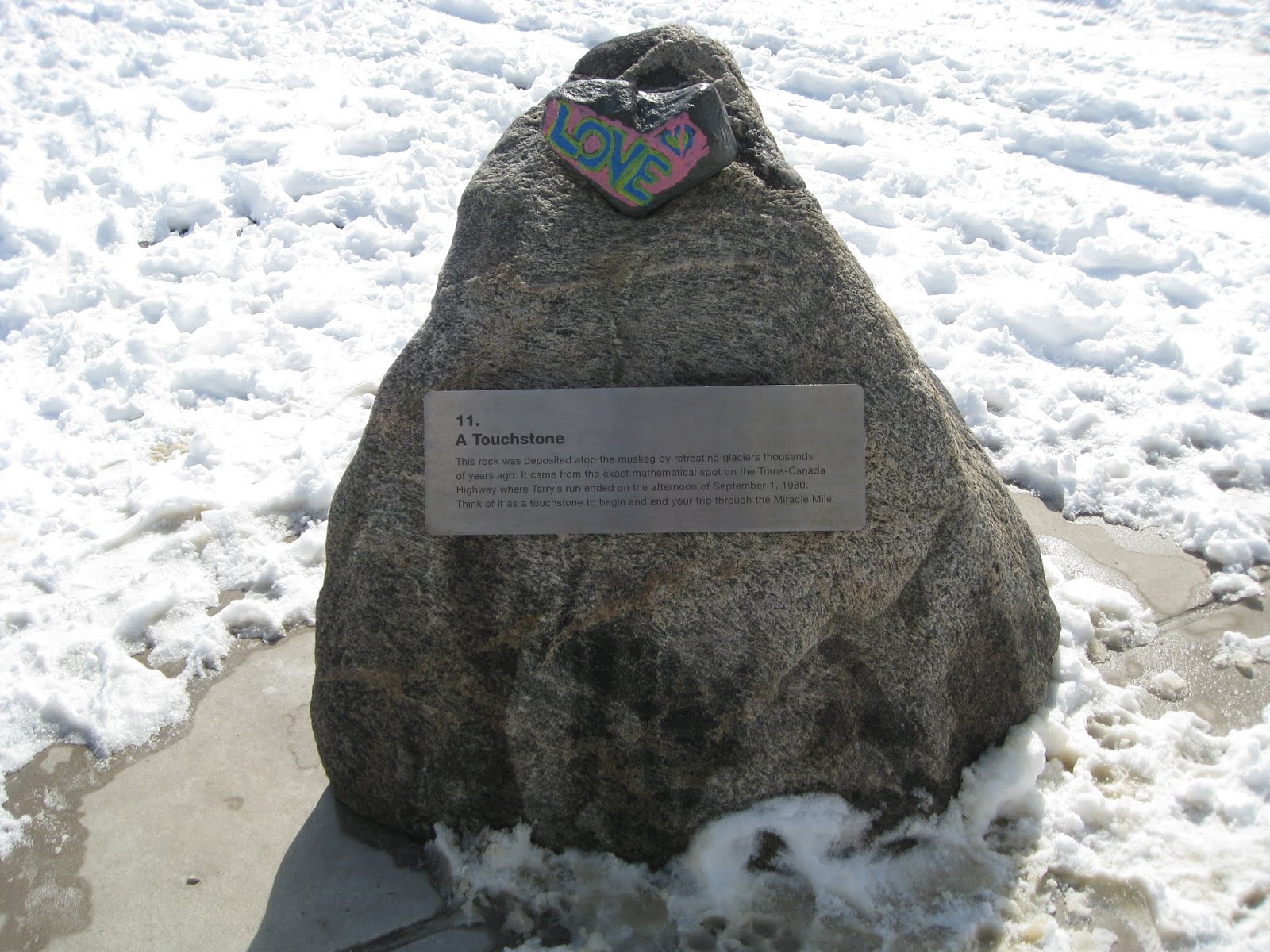
5. Terry Fox Miracle Mile: It's a one mile run named after Terry Fox, the Canadian athlete who ran the cross-country Marathon of Hope in April 1980 to raise money for cancer research. His life story and actions are incredibly moving and inspiring.

Map of Terry Fox Miracle Mile

6. Heart-Shaped Stone: This bronze artwork was cast from a stone retrieved by Terry Fox's brother at the end of his journey. Terry Fox was forced to end his run after 143 days and 5,373 kilometres (3,339 mi). He died at the young age of 22.

Heart-Shaped Stone

The beautiful sunshine encouraged me to continue my walk from Canoe Landing Park to the lake front. There I saw lots of seagulls, ducks, birds, and a few white swans.

Seagulls on Lake Ontario

Swans in Toronto Harbour

Then it was time to head home. I felt great and relaxed after walking outdoors in the sunshine and observing nature. Another fit and fun walk done, another good day!

I'd love to hear your comments.

Sunday, 14 October 2018

Postcard from Auvers-sur-Oise, France


Just over half an hour's drive from Paris and the Orsay Museum, lies the artists' village of Auvers-sur-Oise. Admirers of Vincent van Gogh and other 19th century landscape painters come here from all over the world to be in the very spots depicted in so many well loved paintings. The village is 7 kilometers long (about 4.4 miles). The best way to discover it is on foot.

We made our first stop at the Auvers-sur-Oise Tourist Office to pick up a map and asked a few questions. The weather was cloudy with good chance of rain so we decided to walk the short pedestrian circuit of two hours, as opposed to the longer circuit that would take up to 4.5 hours.

On this walk, we started from Van Gogh Park, discovered places painted by Vincent van Gogh, and ended at the cemetery where the graves of the two van Gogh brothers are located. Below are my photos from Auvers-sur-Oise:

#1) Van Gogh's statue designed by the sculptor Ossip Zadkine in 1961. It is located in Van Gogh Park just outside of the tourist office.

#1) Vincent van Gogh statue

#2 and #3) Auvers-sur-Oise Town Hall which was depicted in van Gogh's La Mairie d'Auvers painting. The town hall is across the street from the inn, Auberge Ravoux, where van Gogh spent his last seventy days.

#2) Auvers-sur-Oise Town Hall

#3) La Mairie d'Auvers copy

#4) Van Gogh's residence at Auberge Ravoux, 52 Général De Gaulle Street, where Van Gogh's room has been left untouched, giving visitors a good idea of the artist's living conditions at the time. There is nothing to see in his room other than a small skylight and an old bistro chair. During his stay at Auberge Ravoux, Vincent van Gogh painted seventy eight paintings. Among these were a dozen or so portraits, two of which depict Adeline Ravoux, the thirteen-year old eldest daughter of the innkeepers Ravoux.

#4) Auberge Ravoux

#5 and #6) Walking towards the church Église d'Auvers, we passed by the Daubigny Museum and the steps where Vincent van Gogh painted L'escalier d'Auvers.

#5) The Daubigny museum

#6) L'escalier d'Auvers copy

#7 to #9) The church, Église d'Auvers, in the Romano-Gothic style surrounded by a bell tower, is characteristic of the region. Vincent van Gogh painted it on June 3 and 4, 1890. It is now a master piece of the Orsay Museum. We were able to go inside the church and took photos. The church exterior was under restoration and had some scaffolding behind the bell tower.

#7) Auvers church tower

#8) Auvers church door

#9) Église d'Auvers painting copy

#10 to #12) The houses in Auvers-sur-Oise looked pretty with their painted windows and doors, or greenery and flowers along the walls. Part of the walk is uphill, providing a good view of the village.

#10) Red doors and windows in Auvers-sur-Oise

#11) Flowers in Auvers-sur-Oise

 #12) Blue doors and windows in Auvers-sur-Oise

#13) The graves of Vincent van Gogh and his brother Théodore in the Auvers Cemetery: Vincent van Gogh arrived in Auvers on May 20, 1890 and died on July 29. He was 37. His younger brother, confidant, and primary supporter, Théodore, died of syphilis six months later at age 33.

Vincent and Théodore van Gogh's graves

The weather forecast was right. As we approached the cemetery, it started raining, first lightly then it became heavier. We were pleased to complete the short pedestrian circuit and saw several key landmarks in Auvers-sur-Oise on this visit.

Are you a fan of Vincent van Gogh's art? Which of his paintings do you like most? Please share.

Tuesday, 25 September 2018

Postcard from Paris River Seine, France


Hello and welcome to another one of my favourite discovery walks in Paris, France! Some of you may have joined me in my previous 5K walk virtually and together we admired the major landmarks in Paris. Today, I'll take you from Notre-Dame cathedral, along the Left Bank of the river Seine, towards the Eiffel Tower.

The river Seine at 777 km long (485 miles) is France's second longest river after the Loire. It flows right through the heart of Paris bordering 10 of the 20 arrondisements. In 1991, UNESCO listed the entire Parisian riverfront, from the Eiffel Tower to the end of the Île St Louis, as a World Heritage Site. 

The weather today is cloudy and wind is calm so it's very comfortable for walking and enjoying the scenery along the river. This walk can be done in the morning if you'd like to see the Eiffel Tower and other buildings at daylight, or in the late afternoon to end it in time to see the Eiffel Tower lit up in the evening. It will be a memorable sight! Or, if you're like me, I start out in the morning and keep wandering, with a few short breaks, until the evening.

First thing first, how do you know you're on the Left Bank of the river Seine? My tip is when you face the river flow downstream (or Downriver), the river bank on your left is the Left Bank, and on your right is the Right Bank. You can look at the water flow or a leaf or debris and see which way it's floating. Do not look at the boats as they go upstream as well.

Second, on this riverfront walk, I'll share my photos of the ten bridges along the river Seine, from Pont St Michel to Pont de l'Alma. Pont in French means bridge. I love their unique designs and the history behind each bridge. Needless to say, there are numerous beautiful buildings along the Seine. To keep this post to a reasonable length, I'll focus on the bridge photos and keep the number of other photos to a minimum. Let's start!

1. Pont St Michel - Constructed under the reign of Napoleon III, the present 62 meter-long Pont St Michel opened in 1857. It links Place St Michel on the Left Bank to the Île de la Cité. Note the initial N in the bridge design. We'll head downstream from here.

Pont St Michel in Paris, France

2. Pont Neuf - Constructed from 1578 to 1607, Pont Neuf is the oldest standing bridge across the Seine in Paris. It is composed of two separate spans, one of five arches joining the Left Bank to the Île de la Cité as shown in my photo below, and another of seven joining the island to the Right Bank. In nice weather, the little island is a wonderful place to hang out, sunbathe, or watch boats.

Pont Neuf in Paris, France

3. Pont des Arts - This bridge differs from many other bridges in that it is constructed of metal and is entirely pedestrian. It links Place de l'Institut on the left bank to the Louvre Museum on the right bank. The view all around this bridge is stunning. In good weather, people come here to picnic and hang out. Below the bridge, on the left and right quays, you'll see joggers, cyclists, strollers, and sunbathers as part of the pedestrian bank has been designated the 'Paris Beach' in the summer.

Pont des Arts in Paris, France

4. Pont du Carrousel - Named by king Louis-Phillipe in 1834, this bridge links Quai Voltaire on the left bank to Quai des Tuileries on the right bank, near the Arc de Triomphe du Carrousel in front of the Tuileries.

Pont du Carrousel in Paris, France

5. Pont Royal - Constructed from 1685 to 1689, Pont Royal is the third oldest bridge in Paris, after the Pont Neuf and the Pont Marie. It links St Germain area on the left bank, to Jardin du Carrousel on the right bank.

Pont Royal in Paris, France

6. Passerelle Léopold-Sédar-Senghor, formerly known as Pont de Solférino, is a footbridge over the river Seine, linking Musée d'Orsay on the left bank and the Jardin des Tuileries on the right bank.

former Pont de Solférino in Paris, France

7. Pont de la Concorde -Constructed from 1787 to 1791, Pont de la Concorde is an arch bridge, linking the Quai d'Orsay on the left bank and the Quai des Tuileries at the Place de la Concorde on the right bank. From this bridge, looking towards the Right Bank, we see the Obélisque at Place de la Concorde and the Sacré-Coeur Basilica in the distance.

Pont De La Concorde in Paris, France

8. Pont Alexandre III looks like the most ornate and extravagant bridge in Paris, connecting the Champs-Elysées quarter with those of the Invalides and the Eiffel Tower. Four gilt-bronze statues watch over the bridge and numerous sculptures feature prominently on the bridge.

Pont Alexandre III in Paris, France

Statues on Pont Alexandre III in Paris, France

9. Pont des Invalides - The current structure was opened in 1855. It is the lowest bridge across the Seine, adorned with sculptures in the Land Victory theme (upriver) and the Maritime Victory (downriver).


10. Pont de l'Alma - Inaugurated by Napoleon III in 1856, Pont de l'Alma is a road bridge, linking Place de la Resistance on the left bank with Place de l'Alma on the right bank. From this bridge, we get a good view of the Eiffel Tower.


The river Seine is a busy waterway. We can take a guided boat tour or dinner cruise operated by Bateaux Mouches, or enjoy a boat ride on the Batobus (boat shuttle service). Personally, I prefer the batobus as it's quieter and with a pass, passengers can hop on hop off at the eight stations in the heart of Paris.

Boats on the river Seine in Paris, France

Bateaux Mouches, Paris, France

Batobus, Paris, France

Voilà, we've just finished our 5K walk along the river Seine in Paris. I love this type of discovery walk which combines fitness, arts, entertainment, social time, and travel along one of the World Heritage Sites. I hope you enjoy the walk as much as I do.

Bridges connect one bank of the river to another, and as we do our virtual walk together, it's natural to have conversations. So let's chat. I'd love to hear your comments.

Sunday, 16 September 2018

Postcard from Paris, France

Greetings and welcome to my virtual discovery walk! Today I'll share with you one of my favourite 5 km walks (about 3.2 miles) in Paris, France, and introduce you to some of the iconic landmarks in the City of Love or City of Light.

I have family in Paris and visit the city frequently, on average once every two years. I'm familiar with where many of the sights are and feel comfortable getting around Paris on my own either on foot or by riding the Metro and RER (regional trains). On each visit, I usually set aside time for nothing but wandering and exploring Paris.

Today I'll start from the Eiffel Tower and end at the Notre-Dame Cathedral. I'll take a short ride on the Metro so you can get a feel for Paris subway system. On this walk we'll view the sights and save the sight visits for another time. Remember to click on the photos to enlarge them.

1. La Tour Eiffel (Eiffel Tower) - On this visit, it was partly sunny and I got a few shots of the Eiffel Tower with blue sky! Below is a photo of the Eiffel Tower from Pont d'Iéna. There is now plexiglass and concrete barriers at the base of the tower for security purposes so visitors must follow the snake-like path to enter the Eiffel Tower. On a previous visit, I climbed up to the first level of the tower and took the elevator to the top level. The view at each level was fantastic.


2. Palais de Chaillot and the fountains - Palais de Chaillot features two curved wings built around a paved courtyard for the 1937 World Expo. It's a museum and entertainment complex. I was happy to see the fountains working as they were not on during my previous visit in summer 2016.


3. Eiffel Tower from Palais de Chaillot - I'm convinced that Palais de Chaillot offers the best view in all of Paris of the Eiffel Tower across the river Seine, plus Parc du Champ de Mars behind it, and all the way to L'Ecole Militaire.


4. L'Arc de Triomphe - From Palais de Chaillot or Place du Trocadéro, we can either walk or hop on the Metro line 6 for three stops and get off at Charles de Gaulle-Etoile station. Follow the sign from the metro station to street level to see L'Arc de Triomphe in the centre of the Etoile (Star) roundabout. This is the world's largest triumphal arch and an internationally recognized symbol of France. The monument was commissioned in 1806 by Napoleon and was completed in 1836. On a previous visit to Paris, I climbed 50 meters up, via 284 steps, to reach the viewing platform on top of the arch. From there, you can see the dozen avenues. One of them is the famed Avenue des Champs Elysées.


5. Avenue des Champs Elysées - This avenue is fantastic for people-watching and it's just pure fun to browse the numerous stores, or to take a coffee break at one of the many eateries. Below is a view of the tree-lined avenue looking towards L'Arc de Triomphe. In the evening, it glitters with lights.


6. Obélisque at Place de la Concorde - Continue east along Avenue des Champs Elysées, we'll reach Place de la Concorde. This vast place was constructed between 1757 and 1777 to provide a home for a monument to Louis XV. The rose granite Obélisque de Louxor was a gift offered by Mehemet Ali, Viceroy of Egypt, to Charles X in 1829. Dating from the 13th century BC, the obelisk, which depicts the deeds of Ramses II, is effectively Paris' oldest monument.


7. Fountain at Place de la Concorde - Also at the vast Place de la Concorde there are huge and beautifully-designed fountains, like the one below. They're a welcoming sight on hot summer days as there is no shade at Place de la Concorde until we reach the Tuileries garden (Jardin des Tuileries).


8. Jardin des Tuileries - Catherine de Médicis, yearning for the public promenades of her native Italy, had the garden built in 1564. Since 1789, it has been one of Paris' most popular public spaces. Walking along the Tuileries, we see rows of trees, shrubs, flower plants, grassy areas, gravel walkways, occasional benches, and many statues. In the centre of the garden is the fountain where green metal chairs are available for resting or launching small rental toy boats.


9. Place du Carrousel- Walking east from the Tuileries fountain, we'll reach Place du Carrousel and the Arc de Triomphe du Carrousel, built between 1806 and 1808. It serves as an entrance of honor at the Tuileries.


10. Palais du Louvre (Louvre Palace) - Exiting Place du Carousel, we'll see Palais du Louvre, the largest palace in Europe with Louvre Museum the largest museum in the western hemisphere. Visitors enter the museum via the glass and metal pyramid designed by I.M. Pei, or directly from the metro. On a previous visit, I was able to see some of the masterpieces in Louvre Museum such as Mona Lisa, the Winged Victory of Samothrace, and the Venus de Milo.


11. Île de la Cité - Leaving the Louvre Museum, we continue further east along the river Seine and cross Pont Neuf to reach Île de la Cité. The island, right in the heart of Paris, is where we'll find Sainte-Chapelle and Notre-Dame Cathedral.


12. Sainte-Chapelle - Completed in 1248, Sainte-Chapelle is a royal chapel in the French Gothic style. If you like stained glass art work, this chapel is a must-see. Arranged across 15 windows, each 15 meters high, the stunning stained glass panes depict 1,113 scenes from the Old and New Testaments.


13. Cathédral Notre-Dame de Paris - Begun in 1163 and completed in 1345, the cathedral façade features magnificently carved wooden portals called the Porte du Jugement (Door of Judgment). 


14. Cathédral Notre-Dame de Paris portals - Check out the incredible details from top to bottom of the façade, and the rose window in the centre. The most significant features of the interior are the enormous stained-glass rose windows that dominate the north and south end of the transept.


15. Cathédral Notre-Dame de Paris spire and buttresses - Walk around the exterior of the cathedral to the park behind it for a good view of the spire and flying buttresses of the apse of Notre-Dame. The park offers a nice spot to rest and admire this remarkable architecture.


16. Cathédral Notre-Dame de Paris side view - To see Notre-Dame side view in its entirety, cross to the Left Bank of the river Seine. I'll pause here and take you on a separate virtual discovery walk along the Left Bank later.


We've now finished our virtual 5 km walk. I hope you enjoy it.

If the 5 km walk is too challenging, it can be broken down or reduced to a more manageable distance. There are also bus and Metro trains that you can take to get around. I didn't mention any break here although it's easily done at any time to enjoy French café and fresh baked goods while watching the world go by. We can also reverse the walk, to start from Notre-Dame cathedral and end at the Eiffel Tower.

I think one of life's pleasures is to wander in Paris. The city is a photographer's dream and is beautiful no matter where you look. There are numerous neighbourhoods to explore such as Latin Quarter, St-Germain, Marais, Montmartre and the Sacré-Coeur, etc. and let's not forget the view from the river Seine so plan a longer stay or come again.

Thank you for joining me today. I'd love to hear your thoughts.